
Calling Member Methods On Literals In Adobe ColdFusion 2025.0.8
As of Adobe ColdFusion 2025 update 8, you can now call member methods directly on struct, array, and string literals. You can also use bracket access on the result of a method call. Historically, you've had to use an intermediary variable assignment. But now, you can chain these operations directly onto the end of a raw literal. To be honest, this doesn't come up very often for me; but, it's come up enough for me to want to explore it.
Caution: you cannot call member methods on numbers. I believe this is true of many languages because it creates a parsing issue. The parser can't tell if the
.denotes a decimal point or a method call. And while JavaScript allows you to wrap a number in parenthesis,(3).toFixed(2), attempting to do so in ColdFusion throws a parsing error.
Here's a quick demo that builds a collection of friends and then sorts them. I'm calling .insert() directly on {} literals, I'm calling .append() directly on [] literals, and I'm using [1] bracket access directly on a method call.
In fairness, I would never use such verbose construction in real life — I'm only taking the scenic route here for testing purposes:
<cfscript>

	// ColdFusion language extensions (global functions).
	include "/core/cfmlx.cfm";

	// ------------------------------------------------------------------------------- //
	// ------------------------------------------------------------------------------- //

	// Member method calls directly on Struct literals.
	steve = {}
		.insert( "id", 1 )
		.insert( "name", "Steve" )
		.insert( "coolness", 0.3 )
	;
	laura = {}
		.insert( "id", 2 )
		.insert( "name", "Laura" )
		.insert( "coolness", 0.87 )
	;
	kit = {}
		.insert( "id", 3 )
		.insert( "name", "Kit" )
		.insert( "coolness", 0.54 )
	;

	// Member method calls directly on Array literals.
	friends = []
		.append( steve )
		.append( laura )
		.append( kit )
	;

	// Bracket-access directly on result of method call.
	coolestFriend = friends
		.sort( coolnessComparator( "desc" ) )
		[ 1 ]
	;
	lamestFriend = friends[ -1 ];

	dump( friends );
	dump( coolestFriend );
	dump( lamestFriend );

	// ------------------------------------------------------------------------------- //
	// ------------------------------------------------------------------------------- //

	/**
	* I return a coolness sort operator using the given direction.
	*/
	private function function coolnessComparator( required string direction ) {

		return ( direction == "asc" )
			? ( a, b ) => ( a.coolness - b.coolness )
			: ( a, b ) => ( b.coolness - a.coolness )
		;

	}

</cfscript>
If we run this ColdFusion 2025.0.8 code, we get the following output without error:
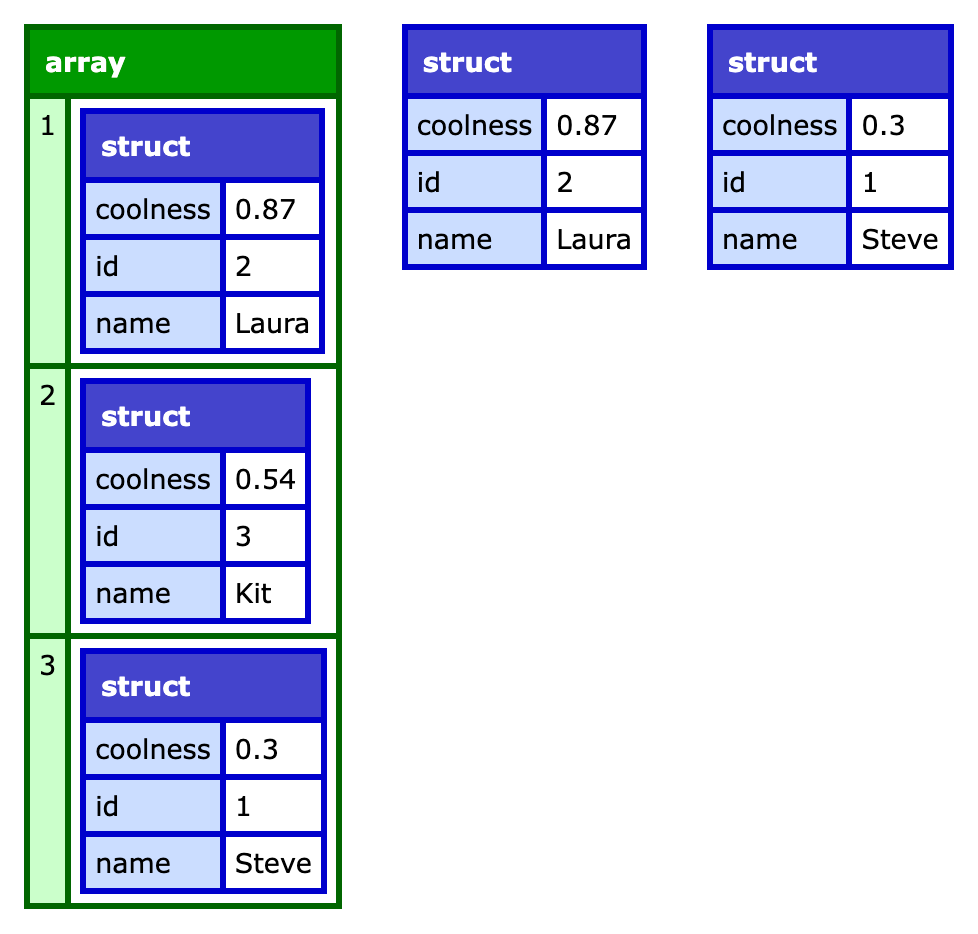
The above syntax might seem a little far-fetched (ie, why would I construct objects like that — even the use of [1] I'd probably replace with .first() just for aesthetic reasons). Something a bit more practical is calling .right() on a string literal in order to left-pad it with zeros:
<cfscript>

	// ColdFusion language extensions (global functions).
	include "/core/cfmlx.cfm";

	// ------------------------------------------------------------------------------- //
	// ------------------------------------------------------------------------------- //

	for ( i = 1 ; i <= 100 ; i++ ) {

		// Pad to three digits.
		echo( "000#i#".right( 3 ) );

	}

</cfscript>
This is a fairly minor update. But I appreciate that this update, along with the BIF-as-callback update, is moving the language in more of a unified direction. Adobe is slowly removing edge-cases and is started to provide unified access to the core functionality, regardless of the shape and / or origin of the values in question.
Want to use code from this post? Check out the license.

Reader Comments
Nice read and thanks for teaching me about Adobe.🙌🙌
@Duvall,
My pleasure - ColdFusion is a really delightful language / application server.
Hi Ben,
There is a little typo there (2x function) :
private function function coolnessComparatorExcept if it's because this function is so cool it needs to introduce itself twice.
It's great that you're still interested in Coldfusion! Keep up the good work.
@Tony,
In this case, the first
functionis the return type and the secondfunctionis just the normal declaration one. So this is a function that returns another function. But, I will agree that it reads weird. No question about that!Ah yes, indeed. That's embarrassing.
Insert the homer hiding in the bushes gif here please
@Tony,
Ha ha, no no, it does read weird! It would almost be better if they could have a
funcas the type instead, just to cut down on that wonky repetition.The funny thing is that even ChatGPT and Claude Code Sonnet got tripped up by that function declaration. They repeatedly claimed that the word "function" appearing twice didn't belong there, and they stuck to that view unless I insisted otherwise.
Ha ha, it's good to know that we can still beat the machines sometimes! 🤣
I have something even better to suggest:
private function function function_( required string direction )...OK I'm out
LOL
Post A Comment — ❤️ I'd Love To Hear From You! ❤️
Post a Comment →