REFind() Sub-Expressions (Thanks Adam Cameron!)
The other day, I was discussing the matching of optional groups in regular expressions, when I stated that accessing the captured sub-groups was something that was only available via the Java Pattern / Matcher. Adam Cameron then pointed out that, in fact, that was what the ReturnSubExpressions optional argument for REFind() was for. Now, I have used REFind() a million and one times, but it is very rare that I actually ever use the optional sub-expression argument. And, when I do use it, I guess it has never been with a regular expression that used captured groups. To be honest, Adam's comment was news to me.
To investigate further, I thought I would give this sub-expression searching a little test drive; I took my Java Pattern / Matcher problem from before and converted it to a REFind() problem:
<!--- Define target string. --->
<cfset strQuery = "ben=nice&maria+bello=sexy!&lori+petty=cool" />

<!---
	Search for our pattern in the string. Use the optional
	4th argument to have ColdFusion return the sub-expression
	matching.
--->
<cfset objMatch = REFind(
	"((([^=]+=[^&]*)&?)+)",
	strQuery,
	1,
	true
	) />

<!--- Dump out sub-expression matching. --->
<cfdump
	var="#objMatch#"
	label="REFind() Results"
	/>
Much to my surprise, the above code gives us the following CFDump output:
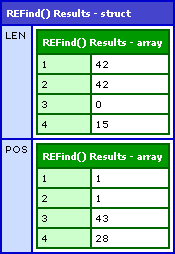
Well I'll be! As you can see, we have four sub-expression results. The first one in always the entire string match. Then indexes 2, 3, and 4 are our captured groups 1, 2, and 3. Unfortunately, since ColdFusion has array indexes starting at one, these captured groups are one off.
Now, let's try to output each of the captured groups:
<!--- Loop over sub-expressions. --->
<cfloop
	index="intI"
	from="1"
	to="#ArrayLen( objMatch.Pos )#"
	step="1">

	#intI#)
	#Mid(
		strQuery,
		objMatch.Pos[ intI ],
		objMatch.Len[ intI ]
		)#

	<br />

</cfloop>
Running this code, we get the following output:
1) ben=nice&maria+bello=sexy!&lori+petty=cool
2) ben=nice&maria+bello=sexy!&lori+petty=cool
3)
4) lori+petty=cool
Let's take that result and compare it to the results found in the Java Pattern / Matcher example with the same regular expression:
1) ben=nice&maria+bello=sexy!&lori+petty=cool
2) lori+petty=cool
3) lori+petty=cool
Interesting. The ColdFusion REFind() method did not find a match for our captured group 2, (([^=]+=[^&]*)&?)+. This group is the repeated group. The Java example stores the last matched group into this reference, but the ColdFusion example seems to ignore this. Peculiar difference.
Regardless, it's a bit sad that I love regular expressions so much and have been using them for quite a while and still didn't realize that this is how ColdFusion's REFind() method worked. Thanks Adam Cameron for bringing this to my attention. I still think the Java solution is much more elegant and useful, but it is proper to know how ColdFusion actually works.
Want to use code from this post? Check out the license.
Reader Comments
Hi Ben,
Looks like the plus sign at the end of the RegEx causes the reFind to get the LAST of each instance. In Java it's the same way, however, Java has the added feature of getting EACH instance of a match if there's no plus sign. Without the plus sign in CF you'll end up with the FIRST instance.
Please correct me if I'm wrong. Still, I can't account for why the strange bug.
Peter
@Peter,
I'm not sure it's a bug. I almost can't wrap my head around what it should even return. It's like trying to step inside of a recursive function, only it's a repeated sub-group.
Basically, if I could dictate what it should do, I am not sure I would have a good suggestion.
Hi Ben,
The second group for ReFind should be the same thing as the Java Pattern Matcher:
lori+petty=cool
This is because the plus sign dictates for CF to find the last instance in the string of (basically):
anything=anything, with or without the ampersand at the end.
but for some reason it fails on the second subgroup. The cool part about the bug is it actually finds the existence of the string for the group, but the pos (43) and the len (0) are completely wrong.
Nice post, most informative.
Peter
@Peter,
Ok, I see what you mean. Glad you like the post. I love finding things that I didn't know that seem so core to the language. I've been coding in ColdFusion for years and I JUST find this?!?
The output from java.util.regex is correct, plain and simple. It is the output you should expect from any regex library when quantifying a capturing group (the last value matched is what the backreference will contain at that point). ColdFusion's output is no feature... it's demonstrating some kind of bug.
@Steve,
Thanks. I will log this bug with Adobe.