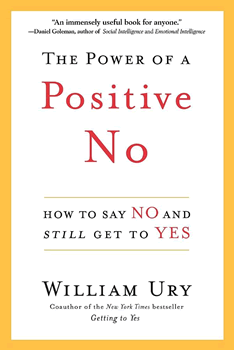
The other week, I was listening to a recording of Whitney Hess responding to user-experience questions. As part of one of her responses, she mentioned the book The Power of a Positive No: How to Say No and Still Get to Yes by William Ury. The title sounded quite intriguing. As someone who is naturally conflict-adverse, the idea of embracing "No" seemed like something that could have a considerably beneficial impact on my life. And, having just finished the book, I can say that it has, indeed, already enhanced the way that I think about conflict resolution.
|
|
|
|
|
|
|
|
 |
|
||
|
|
|
|
Often times, when we are faced with a conflict situation, one of three paths is chosen: either we say Yes out of guilt or compromise; we say No out of fear or anger; or, we simply try to avoid the conflict altogether by avoiding the person on the other side of the situation. The problem with this is that all of these choices lack a positive meaning. And, whether we say Yes or No, we fail in the long term.
In the book, William Ury advocates saying No to the things that you don't want; but, qualifies that a No is only successful when it is initially a "Yes" to your own values and interests. A truly positive No is actually composed of three different parts: Yes-No-Yes.
- Yes: The initial Yes is to yourself. This Yes is about self-respect and confidence and is an acknowledgement that you are someone who has the right to be happy. Saying Yes to yourself allows you to embrace your own personal interests in order to build a platform for your positive No.
- No: This is you saying No to the other person. It is important that this is an action, not a reaction. While it might seem very different to say No in anger or Yes in compromise, the two are fundamentally the same: they are reactions that distract you from your own needs. When you say No to the other, it is critical that you are saying Yes to yourself in a meaningful way.
- Yes (the second Yes): The final Yes is to your future and to a mutually beneficial relationship between you and the other person. With this Yes, you are suppose to provide or explore ways in which you can evolve the situation into something that works for both parties over the long term.
While this might seem like common sense, it's an uncommonly powerful mindset. From the moment that I started reading this book, I immediately began to think about conflict in a positive way; rather than concentrating on saying No, I started to focus on saying Yes to myself. And, when I started to do this, I found that I was able to deliver my No with much more conviction, meaning, and respect.
Now, the Yes-No-Yes approach isn't just about respecting yourself; it's also about respecting the other person. Ury repeatedly drives home the point that you should always have respect for the other person, no matter what. Respect does not mean that you have to like the person or agree with what they want from you; respect simply means that you are giving value to this other person as a human being. You are treating them as you would want to be treated. Respect like this does not come from weakness; on the contrary - being able to respect someone else in the face of adversity emanates from the strength of your own convictions and self-respect.
To get a sense of what I mean by the three-part Yes, let me present a situation that I think all of us in the web development world will be able to relate to: A friend or family member asks you to build a website for them. Here is how I see a Yes-No-Yes approach being applied in this type of scenario (assuming you want to say No):
Yes to Self: My time is very valuable. It is my time that allows me to stay current on emerging technologies, strengthen my skills, and keep in touch with my friends. By using my time in this way, I am able to add value to both my own life as well as to the others in my community. My "yes phrase" is, "Time."
No to Other: I think it's great that you want a web site; you know that I'm a huge fan of your music/art/poetry/interpretive dance/etc. and I'd love to see see you share it with more people. I'm not sure that I'm the best person for building personal web sites - my purview is more along the lines of Enterprise Software.
Yes to the Future: What you need might be as simple as a WordPress theme or a Tumblr account. Let me ask around and see if anyone knows how to quickly set one of those up; I'm sure that we can get something up and running for very little cost.
While I can't be sure that this completely embodies the principles of the Positive No, I think that I'm on the right track. We start off by stating our own needs and interests; by embracing what is important to us, it lessens the guilt we might feel about saying No to someone with which we have a close relationship. Then, we say No to the task of building a website. This No, however, is done both with respect to ourselves as well as to the other person and to their reasons for wanting a web site. Then, our final Yes is a yes to a mutually beneficial future.
In one final example along these same lines, the author presented another work-related situation in a section about "Naming the Game." In this section, he demonstrated that it can be very useful to identify the mental games that people are using against you in a conflict situation. The following passage happen to have struck a significant chord in me only because I have had many people in my life use such similar tactics:
"Come on! Please - you're the resident genius on finance, I'll be lost without you. Only you can help me."
Game: Flattery.
"By why? It's only a little piece of work. You can do it easily in your spare time."
Game: Minimization and Slipper-Slope.
"I've done lots of things for you. Now, please do this one thing for me."
Game: Guilt and Emotional Manipulation.
"But you said you would help me."
Game: Misrepresentation.
"So That's what your word is worth."
Game: Personal Attack.
"What happens if others find out your word can't be trusted."
Game: Threat.
"I thought you were my friend; we go back a long time; we play golf together. Our kids are friends."
Game: Guilt.
"Next time, when you need something from me, I'll remember this."
Game: Threat.
"Ok, I'll tell you what: just help me out in the beginning and if it's too much, you can stop."
Game: False Promise and Slippery-Slope.
"Just wait until the boss hears about this."
Game: Threat.
There's a lot more to the book, including strategies and heart-warming examples from leaders like Mahatma Gandhi and Nelson Mandela. Like I said above, I started putting this mindset to work the moment I opened the book and I have already found it to be beneficial. While the premise is simple, the subtle shift from No to Yes is a profound change. I'm kind of excited to see how I can apply this more often.

Reader Comments
Interesting...this is my current read, half way through the book now. I too avoid conflict and am really looking forward to trying the yes, no, yes method (I might even be looking a little too forward). Great, concise review.
"By why? It's only a little piece of work. You can do it easily in your spare time."
That is my favorite since a lot of people in our profession don't grasp the amount of work it takes or the affect it will have on others.
One thing to watch out for is the time it takes to answer Yes or No. An emotional response tends to be quick so even if you have thought of the consequences to your answer the other person may think you didn't take the time to think about it yourself. I have had this happen many times. I am so analytical I can decide quickly. Now I have learned to slow my response time so it doesn't look like an emotional choice.
@Mark,
I've been finding it great even when thinking about dealing with clients. When you start out by saying Yes to a level of quality you want to put into your software, it becomes much easier and more meaningful to saying No to rush work. Now, I haven't *actually* tried that yet - only internally within the company. But still, I am enjoying the mental shift.
@Blain,
Absolutely agree. In the book, Ury continually refers to "going to the balcony." He had one story about a man who needed to make a tough decision and knew he needed some time to think about it. The man excused himself and stepped out on his (actual) balcony for a while to consider his answer. After that, the author kept referring to your "going to the balcony" moment as the time it takes you to reflect and come back with an active (not a reactive) response.
@Ben,
Just FYI, William Ury was part of the Harvard Negotiation Project, and coauthored their earlier book, entitled simply "Getting to Yes":
http://www.amazon.com/Getting-Yes-Negotiating-Agreement-Without/dp/0140157352/ref=sr_1_1?ie=UTF8&s=books&qid=1285101841&sr=8-1
There's also a follow-on 2nd edition:
http://www.amazon.com/Getting-Yes-Negotiating-Agreement-Without/dp/B001TI3OFA/ref=sr_1_3?ie=UTF8&s=books&qid=1285101841&sr=8-3
@Steve,
He mentioned the other books in the intro to this one (Positive No). I wonder if they would be worthwhile to read after this one? Or, would it be mostly back-peddling.
I haven't read the "Getting to Yes" second edition, but I loved the first one. When my sister set up private practice as a dentist, I gave her a copy of it. (From my experience as a private consultant, I knew that, when you have your own business, everyone tries to price gouge you, as if you're rich or something.) Later I found out I had given her the book TWICE. She said "I didn't mind. I figured you must've really thought it was a good book to have given it to met twice!"
The book you reviewed seems quite kind-hearted. In contrast, "Getting to Yes" is very hard-nosed. Harvard University started the project with a combative attitude and guiding principle: Maybe no one can profit from a negotiation. Shit happens. But if anyone profits from the situation, Harvard's going to one of those who profits. They approached it as a science and analyzed tons of negotiations and their outcomes. They were in it to win it.
So yes, it's combative. One of the analogies in the book was that they were doing "verbal judo", using their opponents' needs and actions against them. So it's not nearly as kind-hearted as the book you reviewed.
If you like the idea of verbal judo, but you'd prefer something more cooperative in tone, check out "The Gentle Art of Verbal Self-Defense" by Suzette Haden Elgin. She developed quite a following and wrote at least 7 books with variations on that theme. She calls it "verbal judo" too, and she too uses what people say and do as part of her defense. But she's not looking to win so much as avoid being taken advantage of.
Suzette Haden Elgin also talks about the "Satir Modes". If you want to read the original on that, try "Peoplemaking" by Virginia Satir.
Can you tell that my father was a therapist?
@Steve,
I think I will check out "Getting to Yes." I could do with a little bit of a stronger confrontational style. Not that I want to go around picking fights; but, I am a bit of a push-over. It'd be nice just to see how others really stick their ground well.
Thanks for the other recommendations as well; I'll check out their reviews.
Added to my book list along with the HTML5.
At the moment I am finishing off "The Grand Design" by Stephen Hawking. It's a very powerful read I highly recommend.
Glyn
@Glyn,
Sounds cool; Stephen Hawking is definitely a brilliant man. I'll check out the synopsis.